


I Don’t Like What I Look Like Naked. There, I Said It.
Jun 8, 2026
|By Deidre Ann Johnson
Body image menopause — two things nobody prepares you for. I don’t like what I look like naked. There. I said it.
The menopause belly. The look of my thighs. The diminishing muscle tone that I have worked my entire adult life to build. I’m a two-time World Champion Powerlifter who has spent decades in the gym, and I still stand in front of the mirror some mornings with moderate disapproval. If that’s not a testament to how real this menopause transition is, I don’t know what is.
I’m exercising. But if I get off my schedule, getting back on is a whole negotiation. Gone are the days when I hit the gym rain, sleet, or snow without a second thought. Everything is a tick harder and stiffer these days. When the alarm goes off at 5:15am it’s a slow roll to sit up, a careful swing of the legs, and those first few steps are not cute. Not even a little.
This, coupled with building a transition career, leaves me feeling fatigued and flat — and reaching for not-so-healthy ways to self-soothe. We’re not going to name names. You know what they are. So do I.
Let Me Be Transparent About Something
I’m a health and wellness coach with a special interest in helping women through every phase of menopause. I say that because I want you to know: coaches don’t have it together all the time either. We understand firsthand how hard it is to sustain change — because we’re in it too. If it’s hard for us, it’s hard for you, and we are here for you without judgment.
Body Image Menopause: What I’m Actually Doing About It
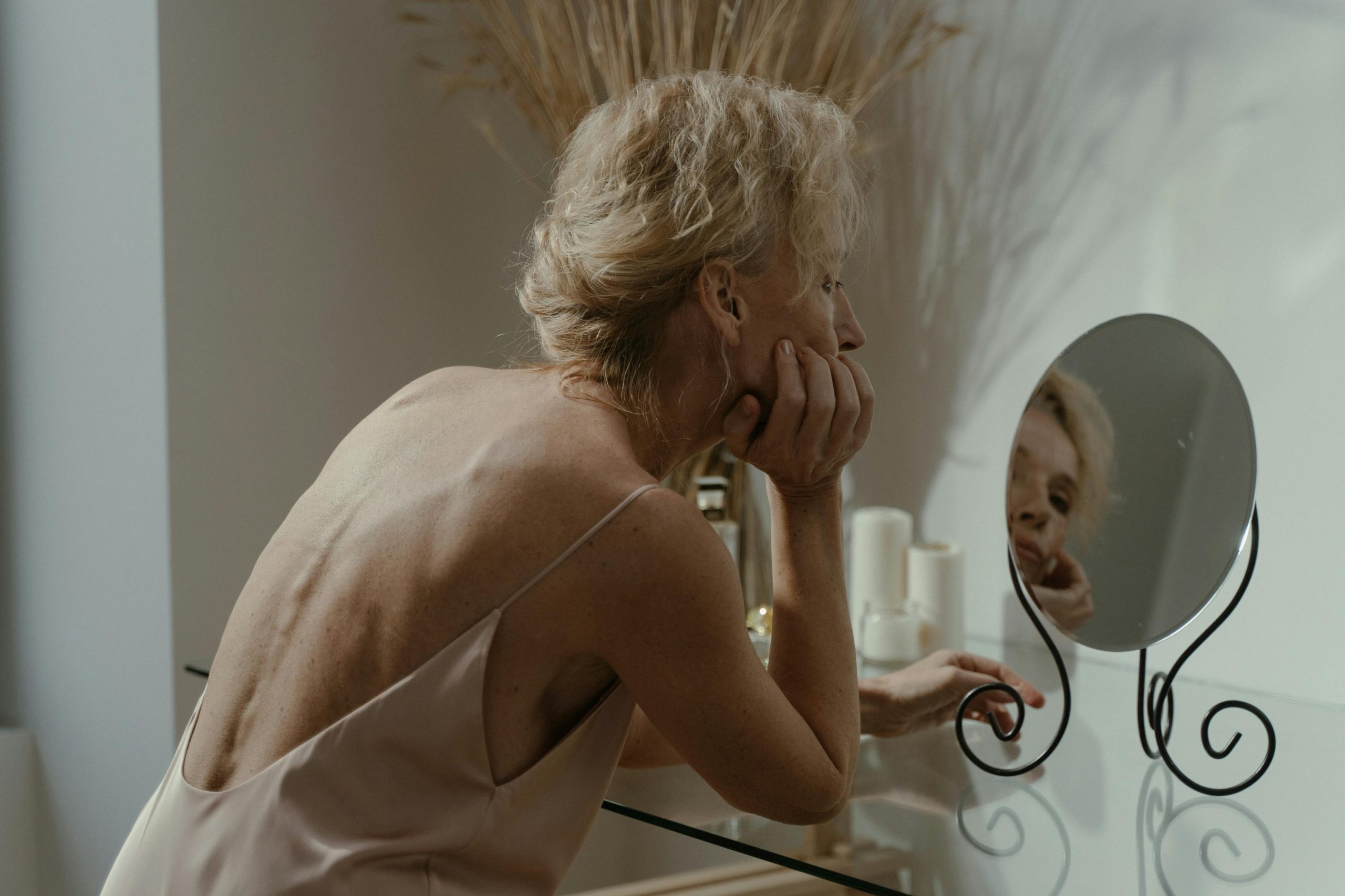
As I stare at myself in the mirror, I have a choice. Disapproval or action. I’m choosing action — but action that’s grounded in reality, not fantasy.
Step one: Let go of the 30s and 40s body.
That body isn’t coming back and chasing it is a setup for failure and frustration. The goal now is to be the best version of myself as a postmenopausal woman in her early 60s. Hormonal shifts and cortisol are real things that require a different strategy — not harder, just smarter.
Step two: Reframe the motivation.
My inspiration can’t just be about how I look or the number on the scale. It has to come from a deeper place — specifically, staying as far away from metabolic syndrome as possible. High blood pressure, high blood sugar, excess belly fat, abnormal cholesterol — these aren’t just aesthetic concerns. They’re the gateway to a whole cascade of disease processes that I am not interested in. My goal is to age with as much grace and independence as possible. Growing older does not have to mean a shoebox full of medications. A lot of this is within my control.
Step three: Supplements that actually support what’s happening hormonally.
I’m taking B12, Magnesium, Marine Collagen Peptides, Vitamin D + K2, and Creatine — all chosen specifically to support declining estrogen levels. Oh, estrogen. How I miss thee. These aren’t magic pills, but they are targeted support for what my body actually needs right now.
Step four: Switch up the workouts before boredom kills the habit.
Thirty minutes on the elliptical makes me viscerally ill just thinking about it. So I’m not doing that. I’ve been doing aerobic routines from The Body Project on YouTube — specifically designed for women 50 and over — and it’s been a game changer. In the gym, I’m alternating heavy lifting with lighter lifting to keep cortisol from spiking and give my body real recovery time. That’s the reason those first steps in the morning feel like a brick — cortisol and inadequate recovery. Smarter programming fixes that.
I also have two specific goals on the horizon: improving my swimming so I can add it as a regular training modality, and running a 5K once my posterior tibialis tendonitis has healed. That last one isn’t just about fitness — it’s about community. A running community is one of the best sources of inspiration and motivation out there, and I want in.
Step five: Sleep like it’s a job.
Same bedtime. Same wake time. Even on weekends. This isn’t punishment — it’s how habits get embedded in the nervous system. Consistency of sleep schedule is one of the most underrated tools for hormonal health, cortisol regulation, and body composition in post menopause. I’m treating it like the non-negotiable it is.
Step six: Get more intentional about nutrition.
My nutrition isn’t bad but it could be better. Coming home after a full day and cooking is not always something I want to do. And listen — how many rotisserie chickens can one person eat before you start clucking when you talk? I can’t. I simply cannot.
So I’m considering a structured meal plan — something I can tailor to a specific dietary approach like Mediterranean, vegetarian, or vegan — that takes the decision fatigue out of the equation on the days when I have nothing left to give.
If you want to go deeper on the relationship between food and how you feel, check out my post on mindful eating for midlife women.
The Wellness Continuum
There’s a concept I use with my clients called the Illness-Wellness Continuum. On the far left is premature death. On the far right is high-level wellness. In the middle is a neutral point — no discernible illness, but no real wellness either. Most people are hovering somewhere in that middle zone, going through the motions without moving in either direction.
The goal — my goal — is to keep moving right. Toward awareness. Toward growth. Toward high-level wellness. And if I do this consistently and with intention, the payoff isn’t just better lab values and more energy.
It’s enjoying what I see when I look in the mirror naked.
That’s the goal. And it’s absolutely within reach.
Want support moving to the right side of your continuum? Book a complimentary discovery call at thewellnesshubnyc.com.