


Coaches Aren’t Perfect. We’re on the Same Path.
Aug 17, 2026
|By Deidre Ann Johnson
Change is hard. I get it. Finding intrinsic motivation to exercise is a constant, quiet battle — making the better choice when the habitual one is so much easier to reach for.
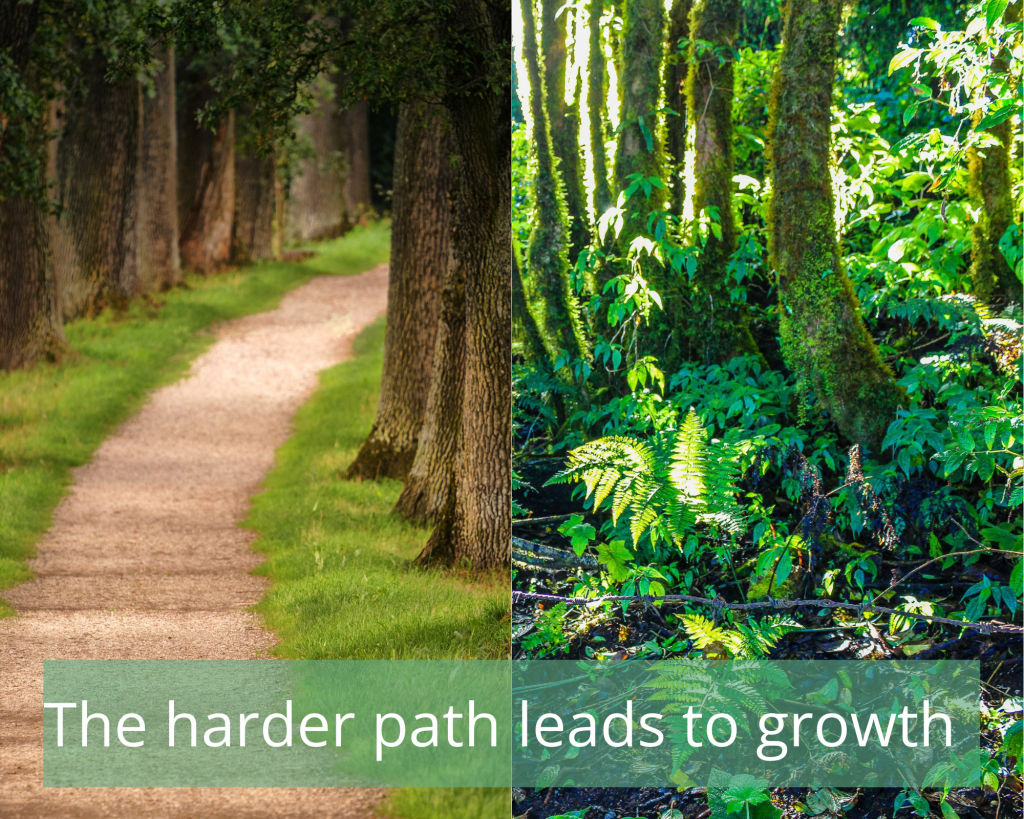
Here’s how I think about it: the habitual path is clear. No overgrowth, no obstacles — just a well-worn trail your feet already know. The new path, the better one, is jungle. Every step forward means swinging a machete through bush and branches. Some days you’ve got the energy for that. Some days you look at the machete, look at the clear path right next to it, and you set the blade down.
People often assume coaches don’t have those days. That we’ve got it all figured out — that our own paths are permanently cleared. We don’t, and they aren’t. We’re making the exact same choice you are, clear path or jungle path, just in different corners of our lives. And whether that choice feels like a fight or feels natural often comes down to one thing: where your motivation is coming from. Outside of you, extrinsic. Or inside of you, intrinsic.
My Own Jungle Path
In another life, I was a powerlifter. Competed multiple times a year, and I was competitive about it — everything I did outside of a meet was in service of winning the next one. That’s extrinsic motivation in its purest form: the goal lives outside you, and it pulls you forward.
Decades removed from powerlifting now, going to the gym is a heavy lift (pardon the pun). As a physical therapist, I know exactly how important lifting is — not just for strength, but for bone density and long-term independence. Between the ages of 30 and 50, both men and women lose 3% to 8% of overall muscle mass. Beyond 50, that loss accelerates to 5% to 8% per decade. For women, research shows that declining estrogen causes muscle loss to happen even faster than it does in men — and it also affects how well muscle repairs, recovers, and rebuilds, one more example of how menopause changes your body in ways that aren’t always visible, the same way it shows up as brain fog in midlife. I know this. I tell clients this. And some days, I still struggle to get myself through the gym doors.
Knowing the facts isn’t the same as feeling the pull. When your “why” used to be a trophy, finding intrinsic motivation to exercise doesn’t happen automatically — so I’ve been working to reframe what the gym is for.
Finding Intrinsic Motivation to Exercise for the 100-Year-Old Me
My goal now isn’t a trophy or a total on a platform. It’s the version of me who’s 100 years old. Every set I do today is something I’m doing for her — for her ability to get up off the floor, carry her groceries, stay independent. That’s the shift from extrinsic to intrinsic: the goal isn’t out there anymore. It lives inside me, in who I want to be able to be.
Part of that reframe is thinking in terms of the illness–wellness continuum, a model developed by Dr. John Travis that places health not as a single fixed point (“sick” or “not sick”) but as a spectrum. On one end you’ve got premature death and illness; on the other, high-level wellness. The middle is a neutral point — the absence of diagnosed disease, but not necessarily thriving. Every choice you make, a workout, a meal, a night of real sleep, moves you a little further toward one end or the other.
I also hold an image of myself as strong and muscular — and I know the only way to actually become that person is to show up, lift heavy, and lift safely. I’m constantly working on that reframe. I’ll keep working on it until it’s not something I have to think about anymore — until it’s just part of who I am again, the way it used to be without effort.
Grace Is Part of the Work
While I’m reframing, I give myself grace. If my body needs rest on a scheduled workout day, it gets rest. If I eat something that lands on the illness side of that continuum, I give myself grace for that too — and I simply don’t make that same choice again the next day. One decision doesn’t define the whole path. It’s just one step, and there’s always another one after it.
This is exactly what coaching is built to do: help you find intrinsic motivation to exercise that comes from inside you, not a goal imposed from outside, so it stops feeling like something you’re chasing and starts feeling like something you’re becoming.
That’s how we’re trained. And it’s the same training we lean on for ourselves.
We’re not ahead of you on this path. We’re right there in the jungle with you, machete in hand.